What it actually says
Article 25 of the regulation states that economic operators may no longer place on the market packaging in the formats and uses listed in Annex V. Point 5 of that annex covers, in direct translation:
single-use packaging for cosmetic, hygiene and toiletry products intended for use in the accommodation sector.
The application deadline for this point is 1 January 2030.
What matters: the text sets no volume threshold. It doesn’t say “under 50 ml” or “under 100 ml”. The criterion isn’t size, it’s use: packaging meant for a single stay, discarded after the guest leaves.
The compliance calendar: the target year is 2029
The ban in Article 25 applies to placing on the market from 1 January 2030. For a hotel, the date is the end of the transition, not its start: on 1 January 2030 the dispensers must be fitted, the refill contract signed and the stock turning over. Bathroom fitting happens in the renovation window, October to March; the last safe window is October 2028 – March 2029.
| Year | What happens |
|---|---|
| 2026 | Inventory: how many rooms still have individual formats, which contracts and until when. The regulation applies from 12 August 2026. |
| 2027 | Requests for quotation, samples, total-cost comparison. 12 February 2027: the Commission publishes the guidelines explaining Annex V, with examples of formats (Art. 25(6)). |
| 2028 | Pilot on one floor, one full season; the decision and the framework contract, in the 2029 budget. |
| 2029 | Fitting in all rooms (Oct. 2028 – Mar. 2029), stock turning over, supplier tested. |
| 1 Jan. 2030 | The legal deadline: suppliers can no longer deliver single-use formats. |
The durations are our estimate from projects, not legal requirements. The full calendar, with the stages and risks, is in the article The PPWR compliance calendar: why the target year is 2029.
Where are you on the 2029 calendar? Request the one-page assessmentPPWR in the minibar and room service
Annex V is not only about the bathroom. Two points touch the room and in-room service:
- Point 4 — single-use plastic individual portions in HORECA: from 1 January 2030, single-use plastic packaging for individual portions of condiments, jam or preserves, sauces, coffee creamer and sugar used in the HORECA sector may no longer be placed on the market. Exception: when supplied together with take-away food for immediate consumption, and in establishments with medical requirements. For the hotel: the room-service tray and in-room breakfast move to portions in glass or ceramic, or to table dispensers.
- Point 3 — single-use plastic packaging for food and drink filled and consumed on HORECA premises (single-use cups, plates, trays): may no longer be placed on the market from 2030. Minibar drinks, pre-packed by the producer, are not covered; the plastic cups next to the minibar are.
- The minibar itself is not covered by Annex V: an Indel B minibar is equipment, not packaging. What changes is what goes next to it: glasses, not single-use plastic cups; sugar and coffee creamer for the tea and coffee set in portions that are not single-use plastic.
- For hotels with a bar or take-away coffee: from 12 February 2027 they must accept customers’ own containers (Art. 32), and from 12 February 2028 offer reusable packaging (Art. 33).
Indel B minibars, with low-consumption modes and full technical sheets, are on the Minibars page; we configure the room set (glasses, tray, kettle) per project.
Sources for both sections: Regulation (EU) 2025/40, Art. 25(1) and (6), Art. 32, Art. 33, Art. 71, Annex V points 3, 4 and 5 (EUR-Lex, checked 11.10.2026).

What falls under the ban, concretely
This wording means we’re not just talking about small shampoo bottles. The entire category of individual formats offered in-room and discarded after each guest is covered:
- small bottles of shampoo, conditioner, shower gel
- body and hand lotion bottles
- individually wrapped bar soaps, in a sachet or box
- other toiletries packaged for a single stay
Individually wrapped bar soap deserves emphasis, because it’s the most common wrong assumption in the market: that the regulation only targets plastic, or only liquids. It doesn’t. The criterion is single-use packaging for a single stay, regardless of material or contents.
What the regulation does NOT say
Here it’s equally important to be precise, because exaggerations in the opposite direction also circulate in the market.
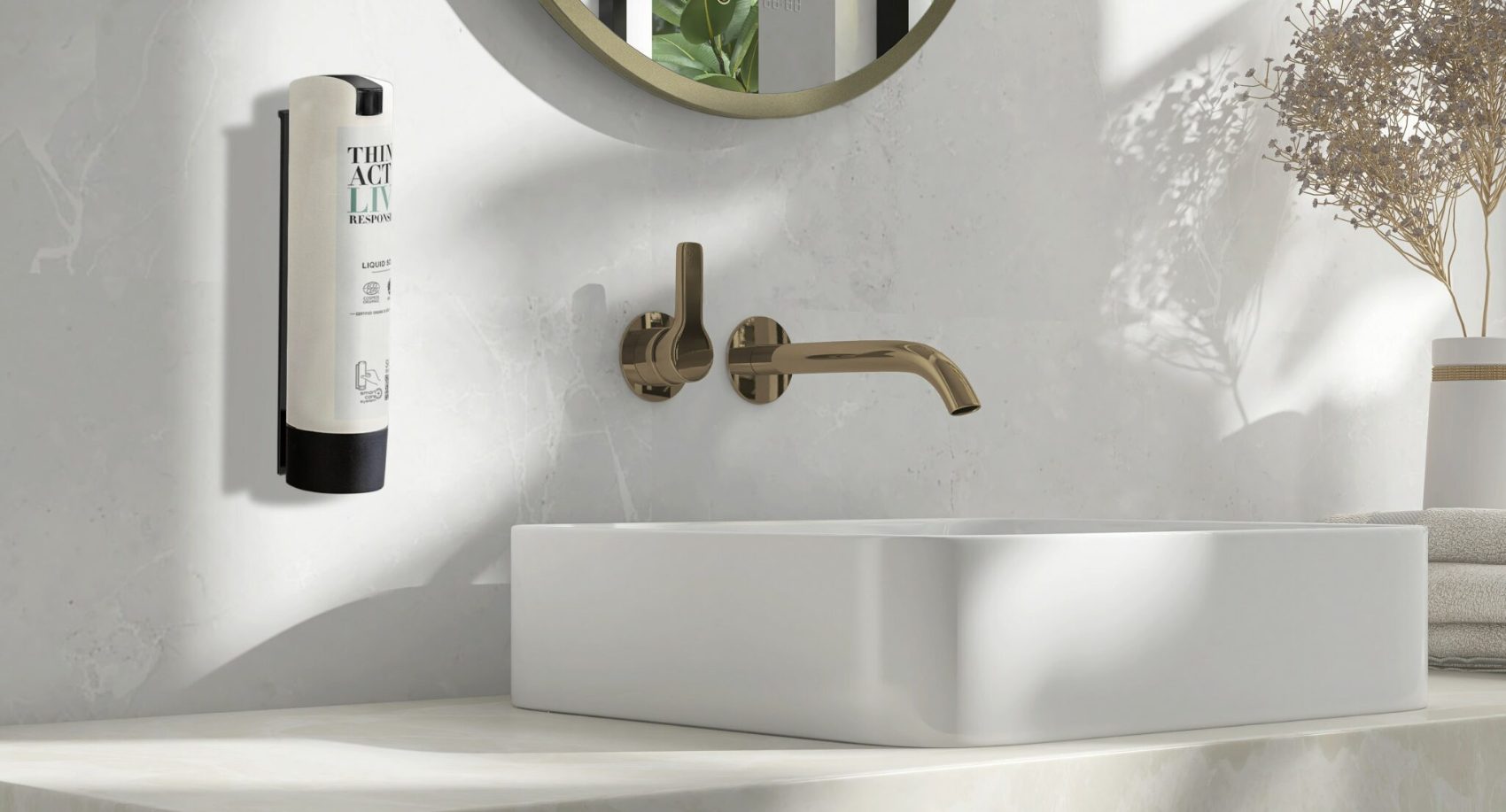
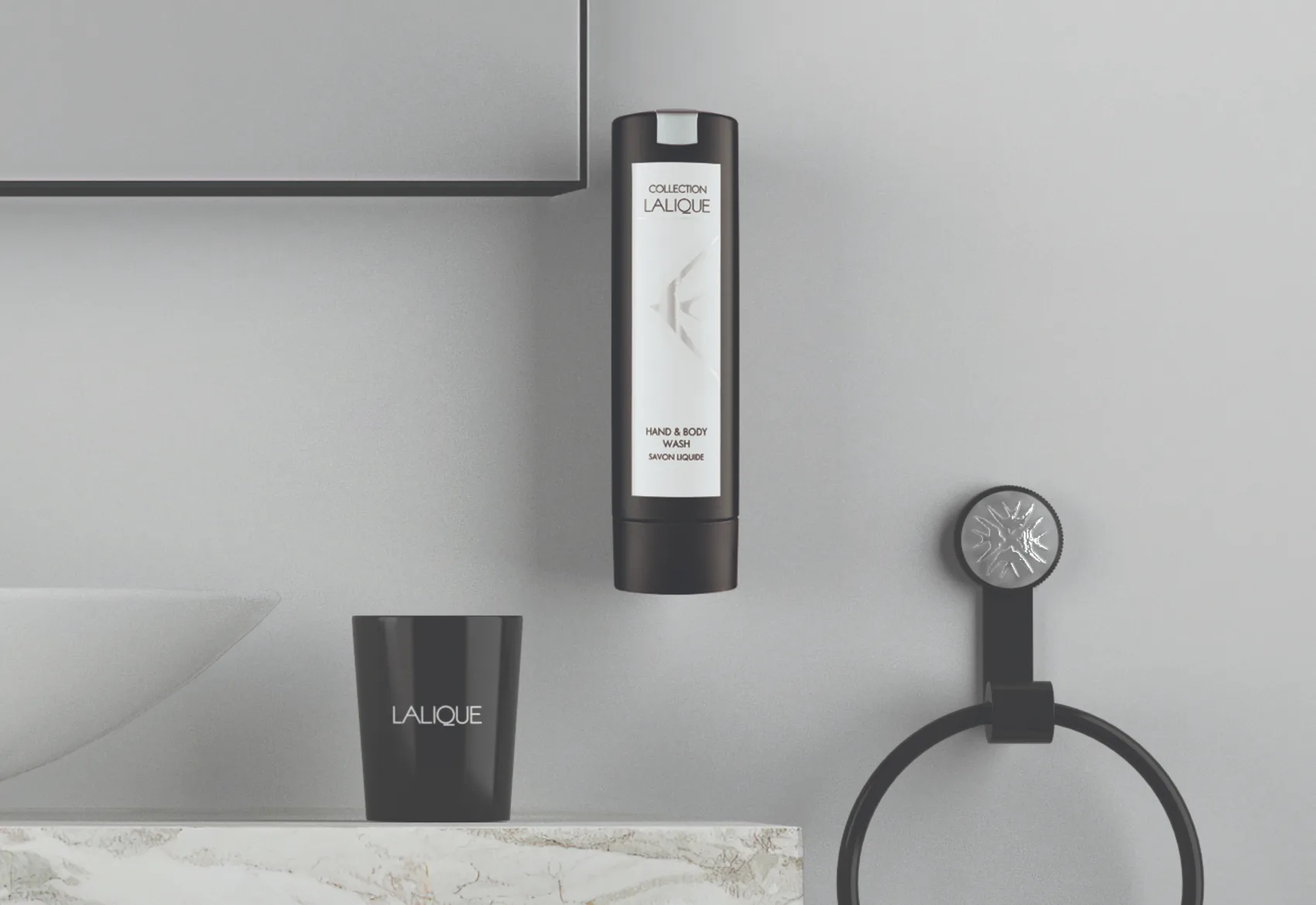
The regulation does not mandate a specific dispenser system. It doesn’t say “install membrane dispensers” or “use 5-litre refills” anywhere. It mandates an outcome — the disappearance of single-use packaging per stay — and leaves the hotel to choose the means: wall-mounted refillable dispensers, countertop pump dispensers, larger reusable formats, or solid products in reusable holders.
It bans neither the cosmetics themselves, nor the brands, nor amenities as a concept. A five-star hotel can remain just as generous with guests after 2030 — it changes the packaging, not the standard.

Why decide now, not in 2029
The purchasing cycle
Cosmetics contracts are signed for one to three years. A contract signed in 2028 for individual formats ends up, at its last delivery, as stock that can no longer be placed on the market. The lines you buy today should already be the ones you’ll use four years from now.
Renovations
Installing bathroom dispensers is a one-time intervention, done at renovation. A hotel renovating in 2027 that installs individual-bottle holders will redo the same bathroom in 2029. Romania’s renovation window — October to March — means this decision gets made three or four times between now and the deadline.
The waste arithmetic
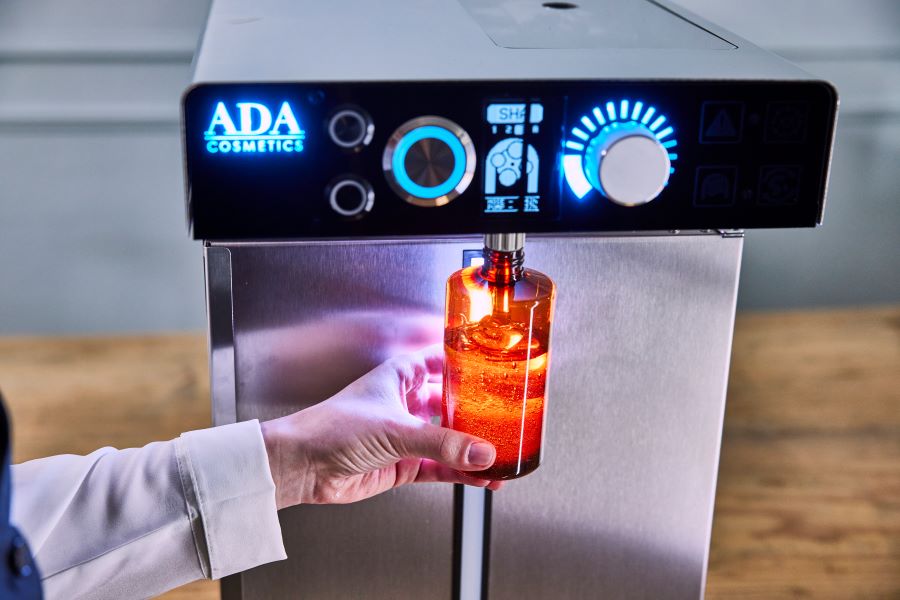
Per the ADA Cosmetics Sustainability Report 2024, the Refillution refill system cuts plastic use by up to 95%, averaging 4.5 kg of plastic waste saved per hotel room, per year.
Source: ADA Cosmetics Sustainability Report 2024. The same report shows 17% of the ADA portfolio was refillable in 2024, up from 13% in 2023, with one million euros invested in R&D that year.
The first question every hotelier asks
It’s not about plastic. It’s: who guarantees hygiene, if it’s refilled?
It’s a fair question, and the answer has to be technical, not just reassuring. In professional refilling systems, the guarantees are threefold: the container stays sealed during transfer, so the product never contacts laundry-room or storage air; each container gets an individual batch number, so filling is traceable; and the pump is peristaltic — the liquid only touches food-contact-grade tubing, never the pump mechanism.
In membrane dispensers, hygiene comes from the construction: the bottle empties completely, and a safe-lock seal shows whether the system has been opened. The independent Rhine-Waal institute in Germany tested this principle and confirmed the absence of back-contamination.
What we do, in practice
For a hotel that doesn’t want to reach 2029 with the decision unmade, the order is simple: first, an inventory of formats used today, by room category; then room categories, since not all switch at the same time; then testing, with a system installed in a model room for a month; and only then the contract.
Concept Hotels has distributed ADA Cosmetics in Romania since 2004. We can do the first two steps together — the inventory and the room-category configuration — and send samples for the third.
Two things still unclear
We’d rather say what isn’t known than give an answer that doesn’t hold up.
Providing on request, at reception
The regulation bans single-use packaging intended for use in the accommodation sector. It doesn’t explicitly say whether an item banned from the room can be offered on request, at reception. The question was formally put to the European Commission (written question E-002490/2025) and a written answer exists, which we haven’t been able to obtain in this review. Until we read it, we state neither that it can nor that it cannot.
Where the category stops
“Cosmetic, hygiene and toiletry products” clearly covers shampoo and soap. It’s less clear for toothbrushes, combs, shoe-shine sponges or sewing kits. The same parliamentary question raises this point too. We don’t yet have an official answer.
If you need a firm position on either point for a contract or an audit, let us know — we’re tracking the clarification and will follow up when it appears.
Regulation (EU) 2025/40 on packaging and packaging waste, Article 25 and Annex V point 5. First entry into force: 12 August 2026 (EUR-Lex, ELI: reg/2025/40).
European Parliament, written question E-002490/2025, “Ban on mini single-use packaging for cosmetics, hygiene and toiletry products in hotels, as provided for in the Packaging and Packaging Waste Regulation (PPWR)” — cites the Annex V point 5 wording and the 1 January 2030 deadline.
ADA Cosmetics, Sustainability Report 2024 (ada-cosmetics.com), Refillution case study: up to 95% reduction in plastic use, averaging 4.5 kg per room per year; 17% of portfolio refillable in 2024 vs 13% in 2023; one million euros invested in R&D in 2024.
Don’t reach 2029 with the decision unmade
We do the first two steps together — the inventory of formats used today and the room-category configuration — and send samples for the third.
Or write to us directly: vanzari@concepthotels.ro
Recommended articles from the Concept Hotels blog
PPWR for Hotels: What Is Banned from 2030 and What to Buy Until Then
From 2030, EU Regulation 2025/40 bans placing single-use cosmetics packaging for hotels on the market.
Regulation & ESGHotel ESG Reporting in Romania: What Applies from 2026
ESG reporting for hotels in Romania in 2026: CSRD thresholds after Omnibus, green claims under GEO 18/2026, packaging, Scope 3.
Regulation & ESGThe PPWR compliance calendar: why the target year is 2029, not 2030
The ban starts on 1 January 2030. Fitting happens in winter, a pilot takes a season, a contract takes a budget.