Small bottles or dispensers: what housekeeping gains
The time and steps small bottles cost housekeeping compared with dispensers: restocking, leftovers, storage. ADA figures and a worked 60-room example.
With small bottles, housekeeping works in units: dozens of items per room every month, which are ordered, stored, placed in the bathroom and collected half-used. With a dispenser, the same work becomes a level check and, at long intervals, a bottle change: with press + wash, a change takes about 5 seconds, and one bottle stands in for 20–25 individual items per month, per room and per product. The difference does not show in a single shift; it shows in the month-end stock count.
This article is written for the executive housekeeper and the general manager: one sees the steps on the floor, the other sees the operating cost and the storeroom space. Below you will find how the two workflows compare, a worked example with its assumptions stated openly, and the questions worth asking before you switch.
What does the team actually do with small bottles?
Each small bottle passes through the same hands several times. For one product in one room, the workflow usually looks like this:
- boxes are received, counted and taken to the storeroom;
- bottles are loaded onto the trolley, by product, at the start of the shift;
- in the room, the attendant checks what the previous guest left and decides what to replace;
- opened bottles are collected and thrown away, if house rules say a started bottle must not reach the next guest;
- at the end of the shift, the trolley is restocked and usage is reported for the next order.
None of these steps is hard. The problem is how many there are: they repeat for every bathroom product, in every room, at every departure. And every bottle thrown away half-full is product you paid for and nobody used.
What changes with a dispenser?
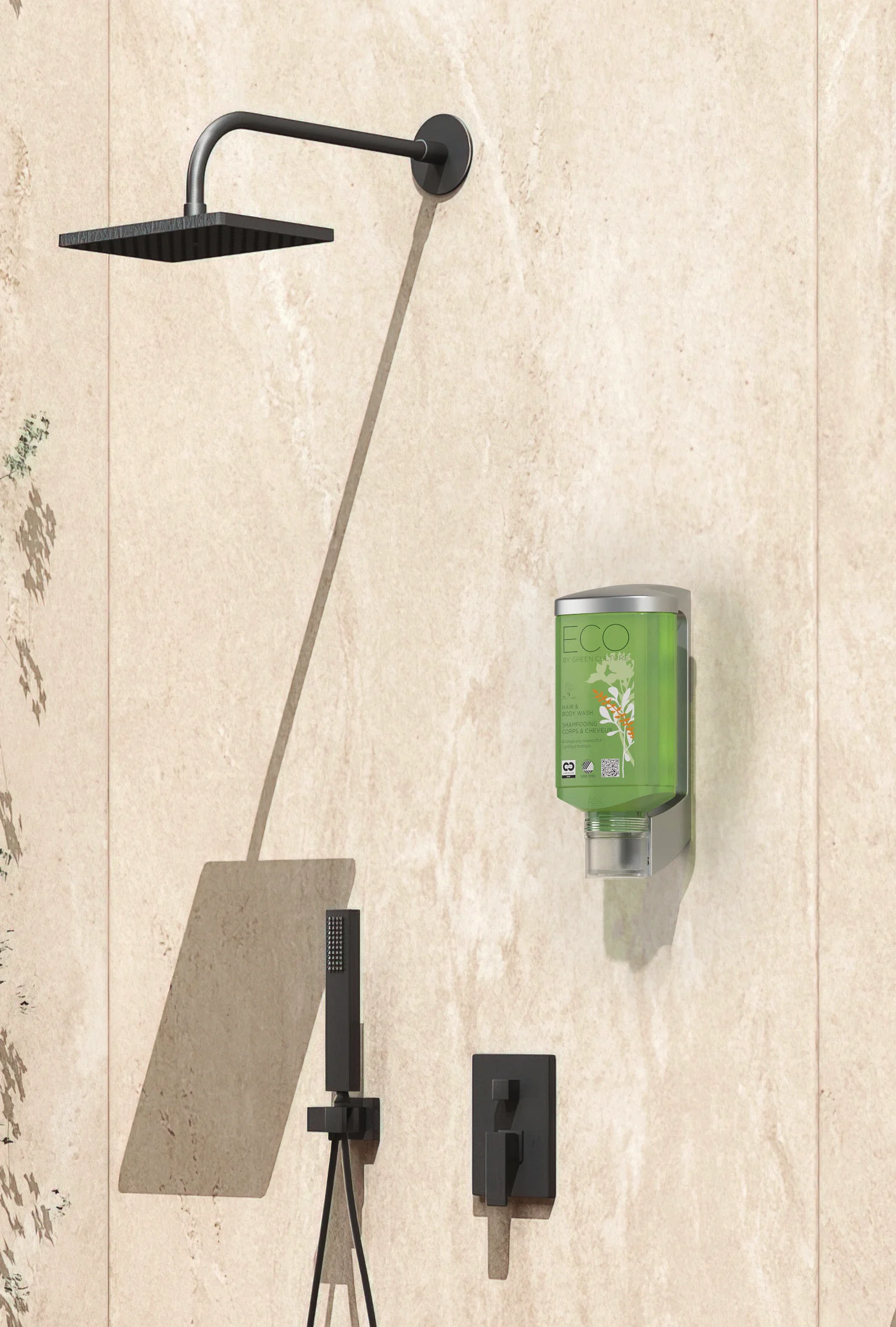
The dispenser stays on the wall. Room attendants no longer replace units; they check the level and change the bottle only when it is empty.
press + wash. A closed system with a patented valve. In ADA's system presentation, a bottle change takes about 5 seconds, and one bottle replaces 20–25 individual items per month, per room and per product. The bottle is released from its bracket with a small key, so guests cannot take it, and the product is used to the end. Details on /dispensers/press-wash.
Refillution. For hotels that want to refill dispenser bottles rather than replace them, ADA has built a controlled process: refilling is automated, in a closed system, from 10 l SmartCube containers. One 10 l SmartCube replaces 34 dispenser bottles of 300 ml. Each container carries a Data Matrix code, so every refill can be traced by batch, and the dedicated trays and trolleys are designed around the housekeeping route. The process is certified by TÜV SÜD to ISO 22716 (good manufacturing practice for cosmetics). Details on /dispensers/refillution and, for refilling in general, on /reumplere.
Would you like to see the system in your team's hands before deciding? We send dispenser and refill samples so your executive housekeeper can test them in a real room. Request samples →
Worked example: a 60-room hotel
The method matters more than the result. The only sourced figure is ADA's ratio of 20–25 individual items per month, per room and per product, against one press + wash bottle. Everything else is an assumption you can replace with your own data.
We assume: 60 rooms, three bathroom products (shampoo, shower gel, body lotion) and one dispenser bottle per room and product per month, which is the rate in ADA's comparison.
| Per month | Small bottles | press + wash dispensers |
|---|---|---|
| Units to handle (60 × 3 × 20–25) | 3,600–4,500 items | 180 bottles |
| Actual changing time | no verified figure | 180 × ~5 seconds ≈ 15 minutes |
| Per year | 43,200–54,000 items | 2,160 bottles |
Two remarks. First, the 15 minutes exclude walking to the room; but small bottles are not handled without walking either, so the comparison holds at the level of the task itself. Second, we have no verifiable per-item time for small bottles, so we do not invent one. Our suggestion: for one week, on one floor, time how long bathroom restocking takes. Multiplied by the figures in the table, it gives you the real cost in working hours.
If the same 180 bottles per month were SmartCare or SHAPE bottles refilled through Refillution (press + wash is not refilled through Refillution), the volume works out at 2,160 × 300 ml = 648 l per year, or about 65 SmartCubes of 10 l. Here we assume every bottle is emptied completely.
What happens to the leftovers?
The started and abandoned small bottle is the loss nobody sees on the invoice. Dispenser bottles empty completely, and ADA estimates, using its own methodology and against small portions, up to 30 % less liquid wasted and up to 95 % less plastic. These are "up to" figures: the real result depends on occupancy, average length of stay and your house rule for opened bottles.
Stock and storage: fewer units, fewer product codes
A hotel working with small bottles keeps thousands of units per month in its storeroom, across several products. With dispensers, the same needs are covered by a few hundred bottles or a small number of refill containers. Stock counts get faster and the risk of running out of a product falls. We have written separately about the method in hotel inventory management.
There is also a deadline that has nothing to do with operations. From 1 January 2030, Regulation (EU) 2025/40 bans placing on the market single-use packaging for cosmetic, hygiene and toiletry products intended for the accommodation sector. What this means for purchases made today is set out in PPWR for hotels: what is banned from 2030.
What about hygiene? Refilling is not the problem
It is the first question any executive housekeeper asks. A study by Rhine-Waal University of Applied Sciences, commissioned by ADA Cosmetics and published in MicrobiologyOpen (2023), examined 104 dispensers from hotel rooms in Germany. The product was heavily contaminated in 67 % of the pump dispensers, while no product contamination was found in the pressure dispensers without a pump.
The useful conclusion for housekeeping: the cause was not refilling but the pump head, where water collects and a biofilm forms. That is why the way a dispenser is built matters more than how often it is refilled. The full explanation, with images from the study, is on /igiena-dozatoarelor.
How to start
You do not need to switch the whole hotel at once. Pick one floor, install the dispensers, measure time and consumption for a month, then compare with a floor still on small bottles. With your own figures in front of you, the decision for the rest of the hotel becomes easier.
Test before you decide. We send press + wash, SmartCare or SHAPE dispenser samples, with the matching refills, for a trial room. Request samples →
Frequently asked questions
How long does it take to change a dispenser bottle?
For press + wash, ADA's system presentation gives about 5 seconds for a bottle change. The bottle is released from the bracket with a small key and a new one is clicked in, with no tools.
How many small bottles does one dispenser replace?
One press + wash bottle stands in for 20–25 individual items per month, per room and per product, according to ADA. The real number depends on occupancy and length of stay.
What does "34" mean for Refillution?
One 10 l SmartCube replaces 34 dispenser bottles of 300 ml. It does not mean 34 dispensers: the brackets stay on the wall and only the bottles are refilled.
Is refilling dispensers hygienic?
The Rhine-Waal University study shows that the problem is the pump head, where water remains, not refilling as such. Refillution adds a closed, traceable process, certified by TÜV SÜD to ISO 22716.
How much liquid and plastic is saved?
ADA estimates, using its own methodology and against small portions, up to 30 % less liquid wasted and up to 95 % less plastic. These are maximum values, not guaranteed for every hotel.
Can I still use small bottles after 2030?
From 1 January 2030, single-use packaging for cosmetics intended for the accommodation sector can no longer be placed on the market, under Regulation (EU) 2025/40. Refillable systems remain the practical answer.
Can I test the dispensers before ordering?
Yes. Concept Hotels sends dispenser and refill samples for a trial room, so your housekeeping team can try them in real conditions.
Sources
- ADA Cosmetics, press + wash system presentation (Sales Support, LSB-PAW, 2021): bottle change in about 5 seconds; 20–25 individual items per month, per room and per product; product used to the last drop. Extracted text in the project document "ada-sales-support-C".
- Concept Hotels, press + wash system presentation (2013): closed system with valve, bottle released with a key.
- ADA Cosmetics, "ADA Cosmetics Refillution: optimized housekeeping in the hotel bathroom", ada-cosmetics.com, 5 September 2025.
- ADA Cosmetics, "ADA Cosmetics Refillution Sets New Benchmark For Efficient and Regulation-compliant Hotel Cosmetics Refilling", ada-cosmetics.com, 1 July 2026 (TÜV SÜD certification, ISO 22716 GMP).
- ADA Cosmetics, Refillution page, ada-cosmetics.com/dispenser-solutions/refillution (10 l SmartCube, 34 dispenser bottles, up to 95 % less plastic).
- Lucassen et al., "A loophole in soap dispensers mediates contamination with Gram-negative bacteria", MicrobiologyOpen, 2023; Rhine-Waal University of Applied Sciences, study commissioned by ADA Cosmetics.
- Regulation (EU) 2025/40 on packaging and packaging waste, Article 25 and Annex V point 5, EUR-Lex.
Last checked: 2 October 2026.