Hotel inventory management: four steps that keep everything under control
This guide builds on the ADA Cosmetics expert story "Hotel Inventory Management: A Practical 2026 Guide for Operations and Procurement" (22 July 2026) and adapts it for a hotel in Romania.
Well-managed stock is invisible. Nobody notices that the shampoo in the bathroom was replaced on time, that clean linen was on the shelf in the morning or that the bulb in the third-floor corridor was changed before it burnt out. Stock only becomes visible when it runs out, usually on the days when the team is already stretched. That is precisely why it is easy to neglect, and the cost of neglect builds up quietly, month after month.
In a guide published in July 2026, the ADA Cosmetics team brought order to the subject for hoteliers in the United Kingdom. We have kept their structure and adapted it for a hotel in Romania, where EU rules apply directly rather than through a local equivalent.
What hotel inventory management actually means
It is the process by which you track, order, store and optimise every physical item the hotel needs in order to operate: from shower gel and towels to kitchen ingredients, light bulbs and tableware. The objective has two equally important parts: nothing should run out, and nothing should sit unused.
What poorly managed stock costs
For the Romanian market, a 2022 Edenred–HORA–Mastercard study shows that 73% of the hospitality operators surveyed (mostly restaurants) had faced food waste, and 55% had already implemented measures to reduce it. This is no longer just a matter of good practice: under Law no. 217/2016, as amended by Law no. 49/2024, food sector operators, including hotels with food service, must report their food waste data on the platform of the Ministry of Agriculture and Rural Development, with fines of 10,000 to 40,000 lei for failing to report. Micro and small enterprises are exempt from the reporting obligation.
The example from the ADA guide worth remembering does not come from a hotel chain but from a family-run hotel in Norfolk that began weighing and recording every type of waste — illustrative, not statistical for the Romanian market. Measurement came first. Decisions about what needed to change became simple once the team saw the figures.
The four steps
Every stock system, from a shared spreadsheet to dedicated software, rests on the same four steps. When something goes wrong, the problem almost always lies in one of them.
1. Track
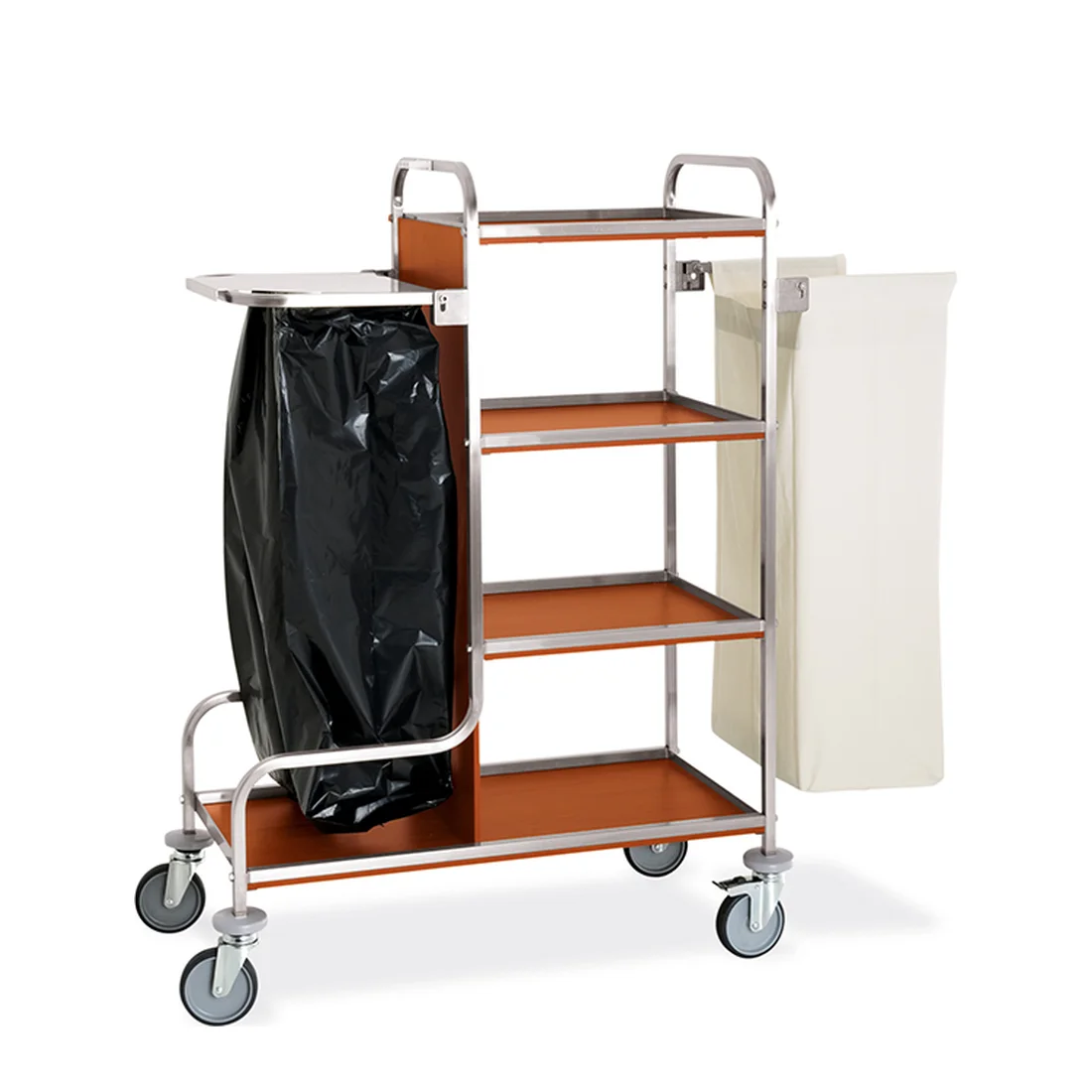
Make a list of every place where stock is held: the main storeroom, floor pantries, housekeeping trolleys, the kitchen dry store, the maintenance workshop. For each category, set a par level (the quantity that covers normal consumption without leaving you short), a counting frequency (high-value items weekly, slow movers monthly) and, crucially, a named owner. Without a name next to each category, the inventory slips.
2. Order
Define the reorder point for each product, calculated from the rate of consumption and the supplier's lead time. A supplier with unpredictable deliveries forces you to hold more safety stock, which means tied-up cash and space. Watch minimum order quantities: a large minimum on a slow-moving product is one of the most common causes of stock that never gets used. Decide who may place an order and up to what value.
3. Store
Rotation: first in, first out. Anything with a shelf life, including opened cosmetics and cleaning chemicals, is rotated by date, not by order of arrival. Small, portable items are kept under lock and key, with a clearly designated person responsible. Check the condition of the space, not just the stock sheet: damp ruins linen and cardboard.
4. Optimise
Most hotels get here last, because there is always something more urgent. Yet this is where the real savings are: reduce the number of product lines, consolidate suppliers for fewer, larger orders, set par levels according to forecast occupancy rather than last year's habits, and treat what you throw away as information, not waste.
The hotel inventory list
In many hotels the list exists in pieces: a spreadsheet in housekeeping, an order book with the chef, some notes at reception. Bring everything into a single document visible to everyone, divided by department, with columns for par level, reorder point, supplier and owner.
| Category | What it includes | Why it causes headaches |
|---|---|---|
| Bathroom and hotel amenities | Shampoo, shower gel, soap, lotion, dispensers, slippers, bathrobes | Constant replenishment; guests notice an empty bottle immediately |
| Linen and textiles | Bed linen, towels, spa and pool textiles | Always on the move: in the room, at the laundry or in the store |
| Food and beverage | Kitchen, bar, minibar, breakfast | Shelf lives and legal obligations |
| Housekeeping and cleaning | Chemicals, cloths, bin bags, paper, tea and coffee | Spread across trolleys and pantries, so easy to miscount |
| Equipment on request | Cots, extra beds, irons, adaptors | They are returned, so they must be tracked both ways |
| Maintenance | Spare parts, bulbs, batteries, fittings | Rarely needed, but costly when missing |
| Operating equipment | Tableware, glasses, cutlery, trays | Breakages and losses are continuous |
Do you need software?
Possibly not. A well-kept spreadsheet is enough for an independent hotel with few product lines and one disciplined person who owns the inventory. The time to move to software comes when several departments order separately, when you have several properties, when shortages keep recurring or when management needs consumption reports on demand.
One thing holds true in both cases: software enforces a good process, it does not create one. Put the list, the par levels and the owners in place first, and only then choose a tool the team will use willingly.
The EU rules that change stock decisions
The ADA guide stops at UK legislation. For a hotel in Romania, what matters directly is Regulation (EU) 2025/40 on packaging and packaging waste: it becomes applicable in all Member States from 12 August 2026, without national transposition. Article 25, together with Annex V point 5, prohibits the placing on the market, from 1 January 2030, of single-use packaging for cosmetic, hygiene and toiletry products intended for the accommodation sector. The text sets no volume threshold: the criterion is not the size of the bottle but its use — packaging intended for a single stay and discarded after the guest leaves. Individually wrapped solid soaps are therefore covered too, not just small bottles of shampoo or lotion. Refillable dispensing systems do not, in principle, fall into this category, but actual compliance depends on the packaging configuration. The Commission is due to publish guidance on Annex V by 12 February 2027, and the treatment of items offered on request at reception is still being clarified. The Regulation does not, however, prescribe a particular system: the choice between refillable dispensers, large reusable formats or solid products in reusable holders remains the hotel's. This is not a reporting issue but a stock issue: the lines you buy today should already be the ones you will be working with four years from now.
Hotel amenities: where you gain time fastest
Bathroom amenities deserve a chapter of their own, for two reasons. They are ordered more often than almost anything else in the hotel, and they fall to the team with the least spare time. They are cheap individually, but the spend adds up, and an empty bottle is noticed within seconds.
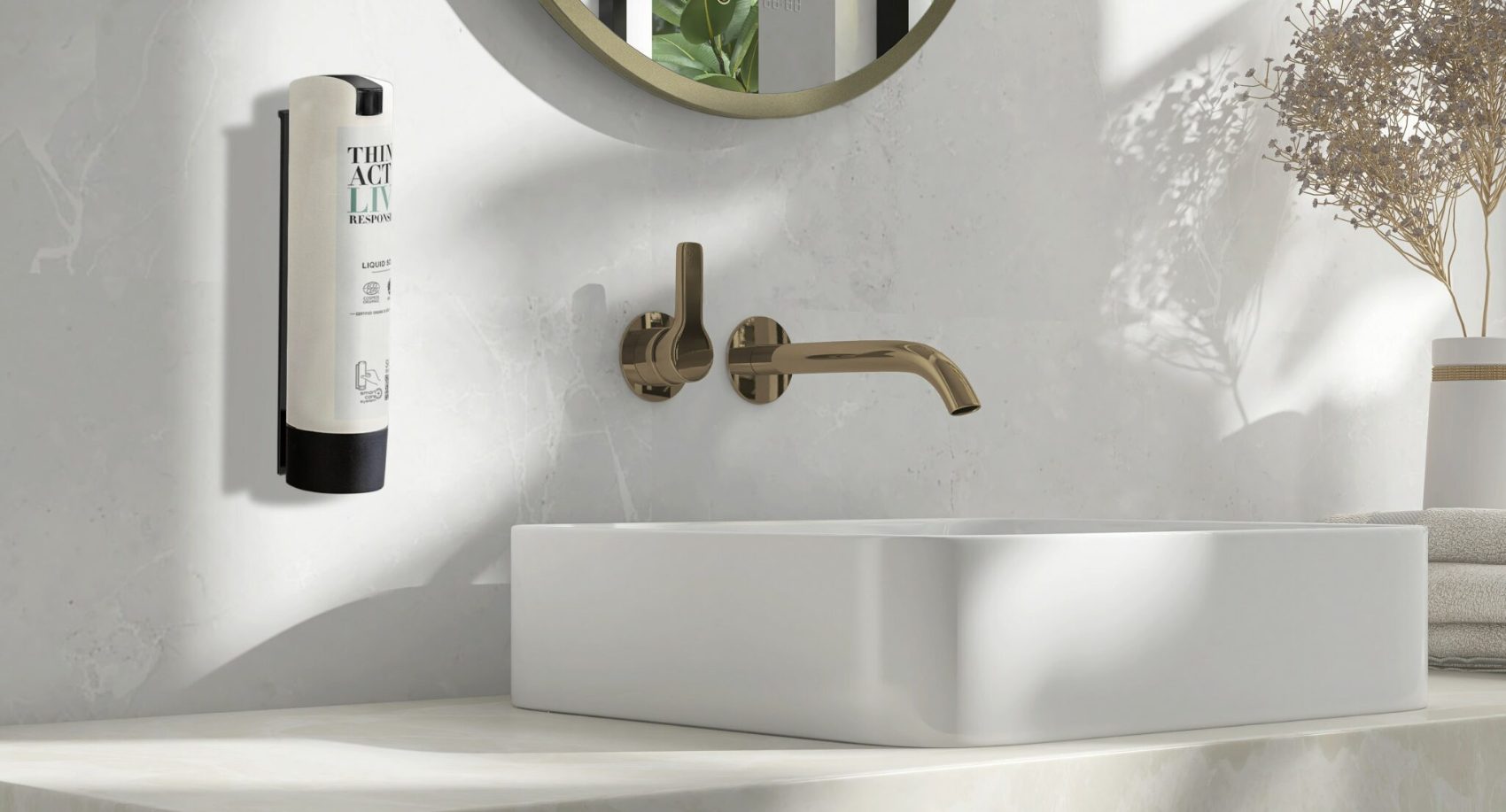
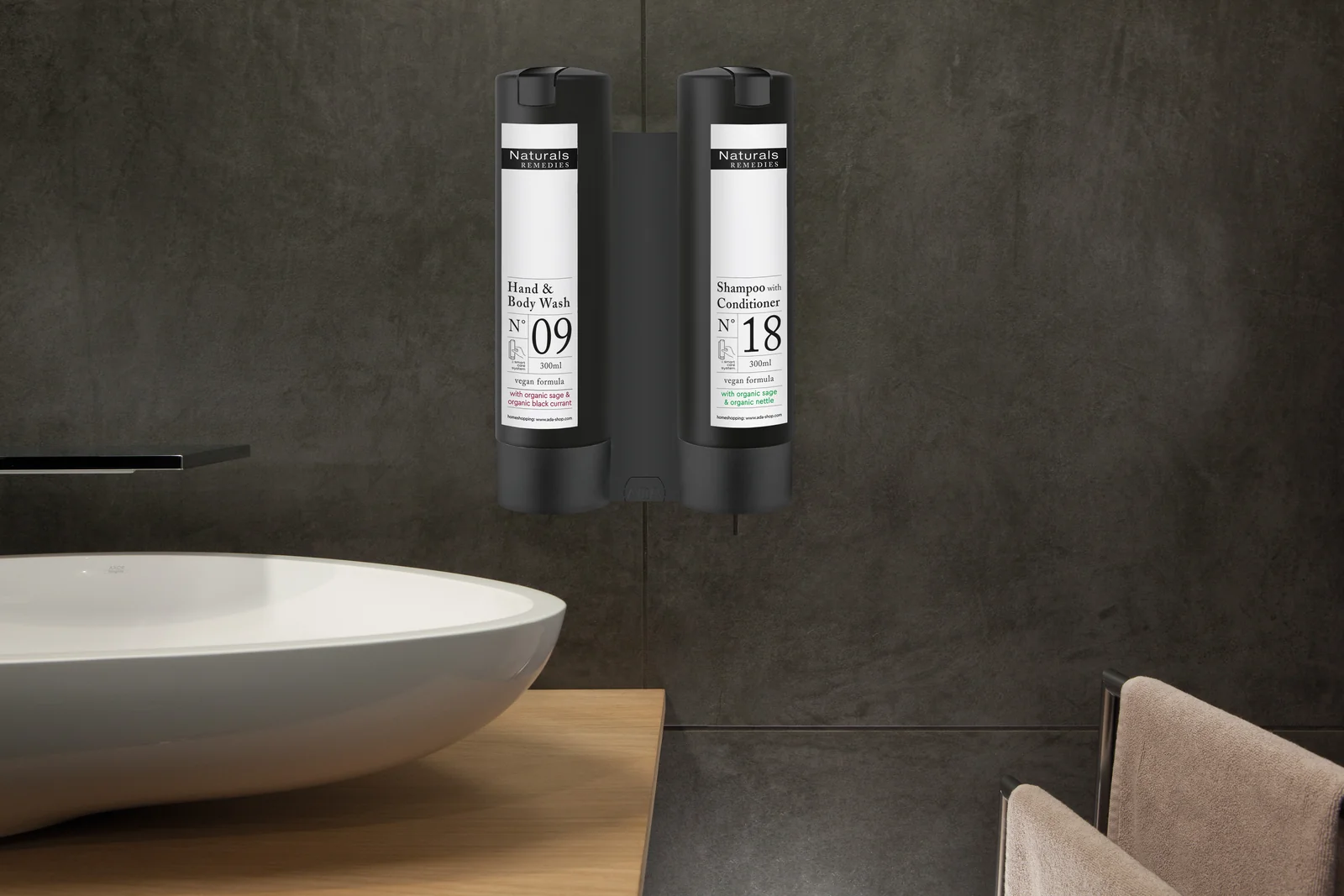
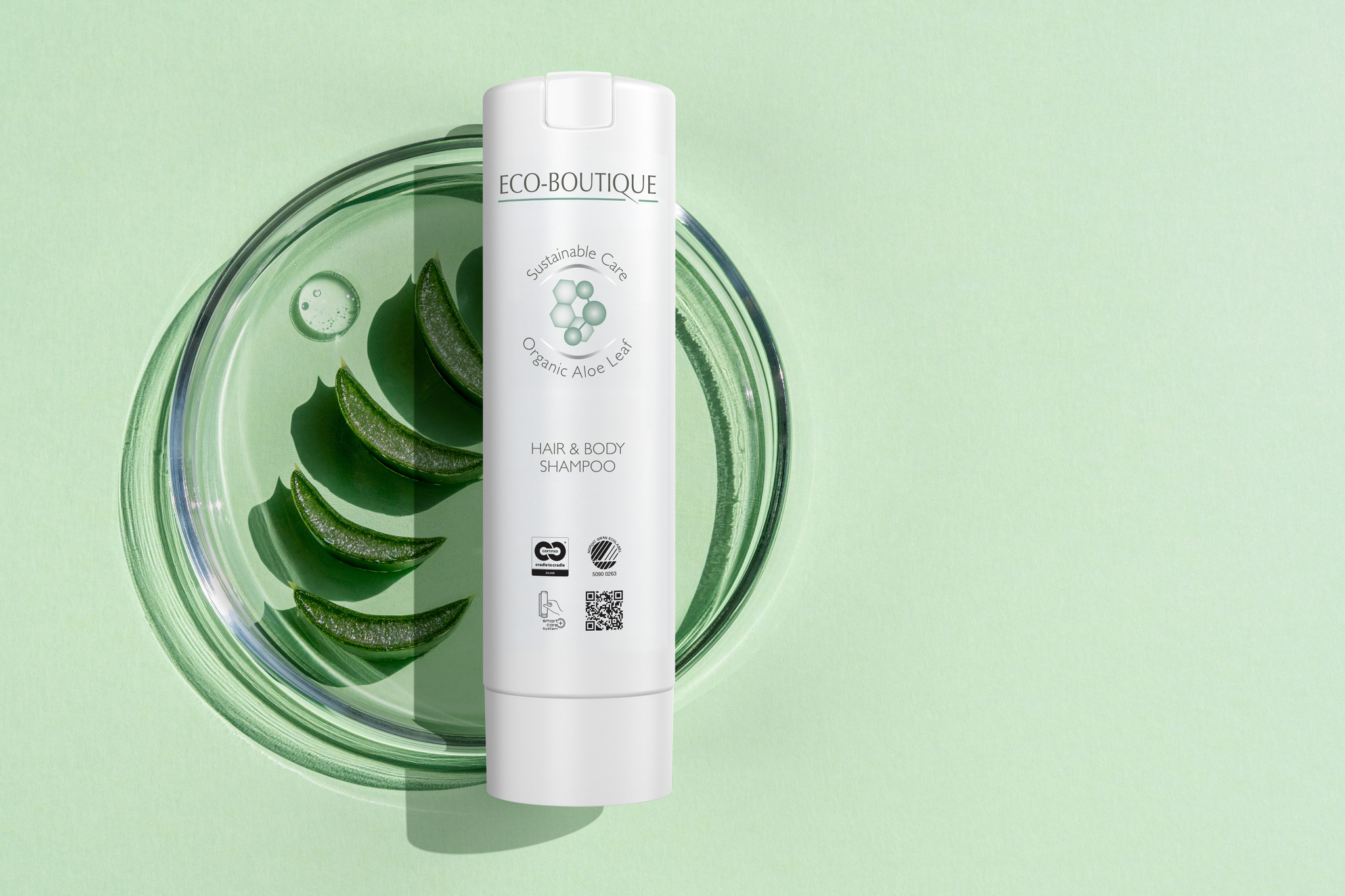
Switching from individual formats to wall-mounted refillable dispensers solves several problems at once: fewer lines to count, store and reorder, simpler par levels and less packaging to handle. Refills also change the arithmetic of the storeroom. A 3 l or 5 l refill replaces a stack of bottles, and the ADA Cosmetics Refillution system, with its 10 l SmartCube box and refilling in a closed loop, replaces 34 dispenser bottles with a single box (according to ADA Cosmetics).
A predictable supplier is itself a stock argument: with consistent deliveries you hold less safety stock. Concept Hotels distributes ADA Cosmetics in Romania, with local delivery, so that par levels for amenities can be calculated on actual consumption rather than on the fear of running out.
If you would like to simplify your hotel amenities inventory, we can propose a configuration of dispensing systems and refills for your room categories: vanzari@concepthotels.ro.
This article is for information only and reflects the legislation applicable on 24 September 2026.
Dragoș Popescu
Dragoș Popescu founded Concept Hotels in 2001. Since 2004 the company has been ADA Cosmetics’ distributor for Romania and the Republic of Moldova, and it works directly with Indel B and Aliseo on equipping hotel bathrooms and guest rooms.
About Concept Hotels →Sources (5)
- ADA Cosmetics, Hotel Inventory Management: A Practical 2026 Guide for Operations and Procurement, Expert Stories, 22 July 2026: https://ada-cosmetics.com/expert-stories/hotel-inventory-management/
- Regulation (EU) 2025/40 on packaging and packaging waste, Article 25 and Annex V point 5: https://eur-lex.europa.eu/eli/reg/2025/40/oj
- European Parliament, written question E-002490/2025: https://www.europarl.europa.eu/doceo/document/E-10-2025-002490_EN.html
- Law no. 49/2024 amending and supplementing Law no. 217/2016 on reducing food waste (in Romanian): https://legislatie.just.ro/Public/DetaliiDocument/280058
- Edenred Romania, HORA and Mastercard, Study on food waste in the local hospitality industry (2022, in Romanian): https://www.edenred.ro/ro/studiu-risipa-alimentara-HORECA