What a hotel puts in its ESG report about amenities
How many miniatures, how much plastic and how much CO2 an 80-room hotel avoids with refillable dispensers: the calculation, its method and its limits.

A hotel’s ESG report usually has a line on packaging, and the figure in it most often comes from the supplier as a general sentence. The ESG sheet we attach to our offer starts from the hotel’s own figures: how many rooms are fitted, how full they are, which products are in the set and how often the miniatures are replaced. From these it produces the number of bottles that are no longer bought, the plastic in the primary packaging before and after the switch to dispensers, and an estimate of the CO2 from that plastic.
A worked example
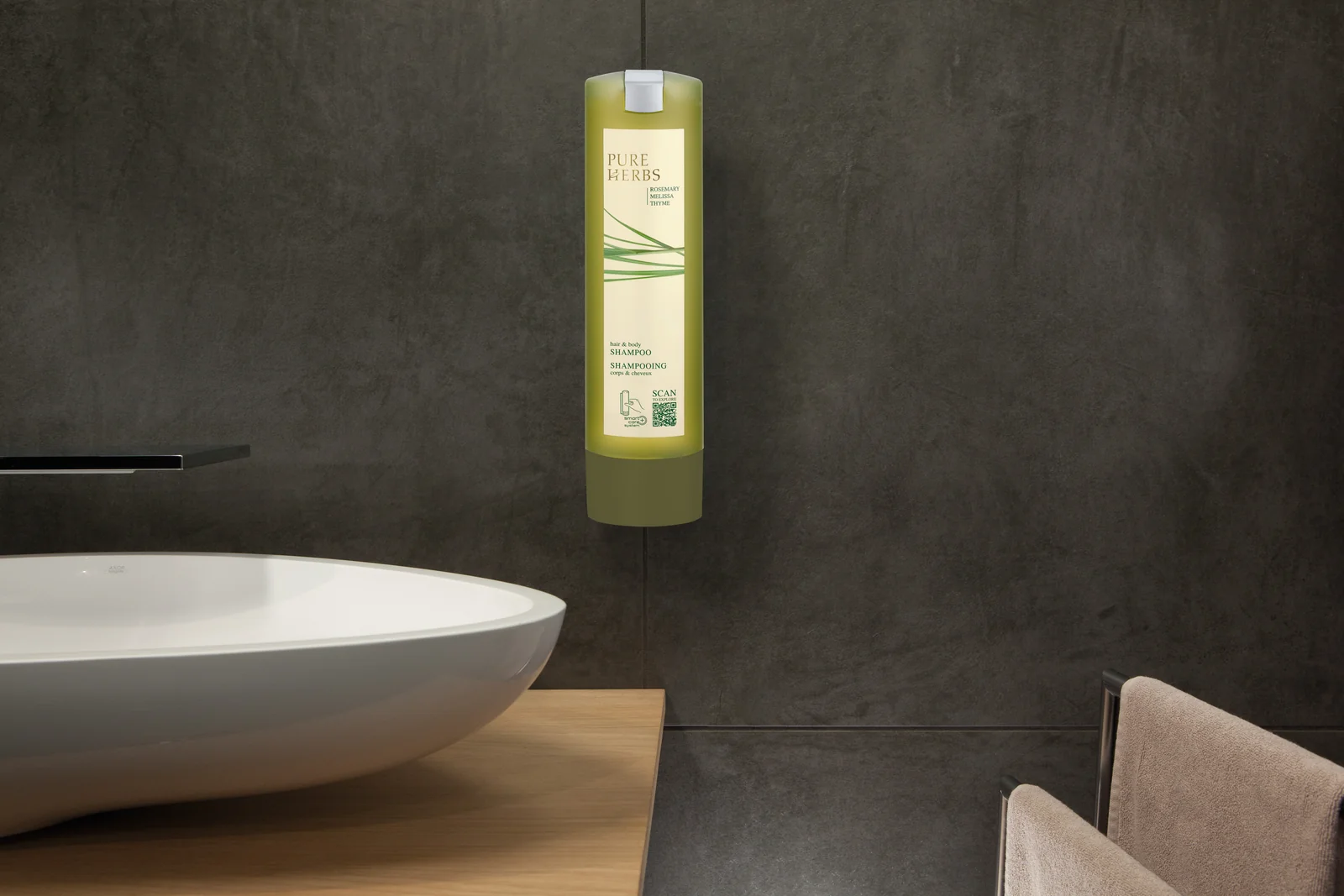
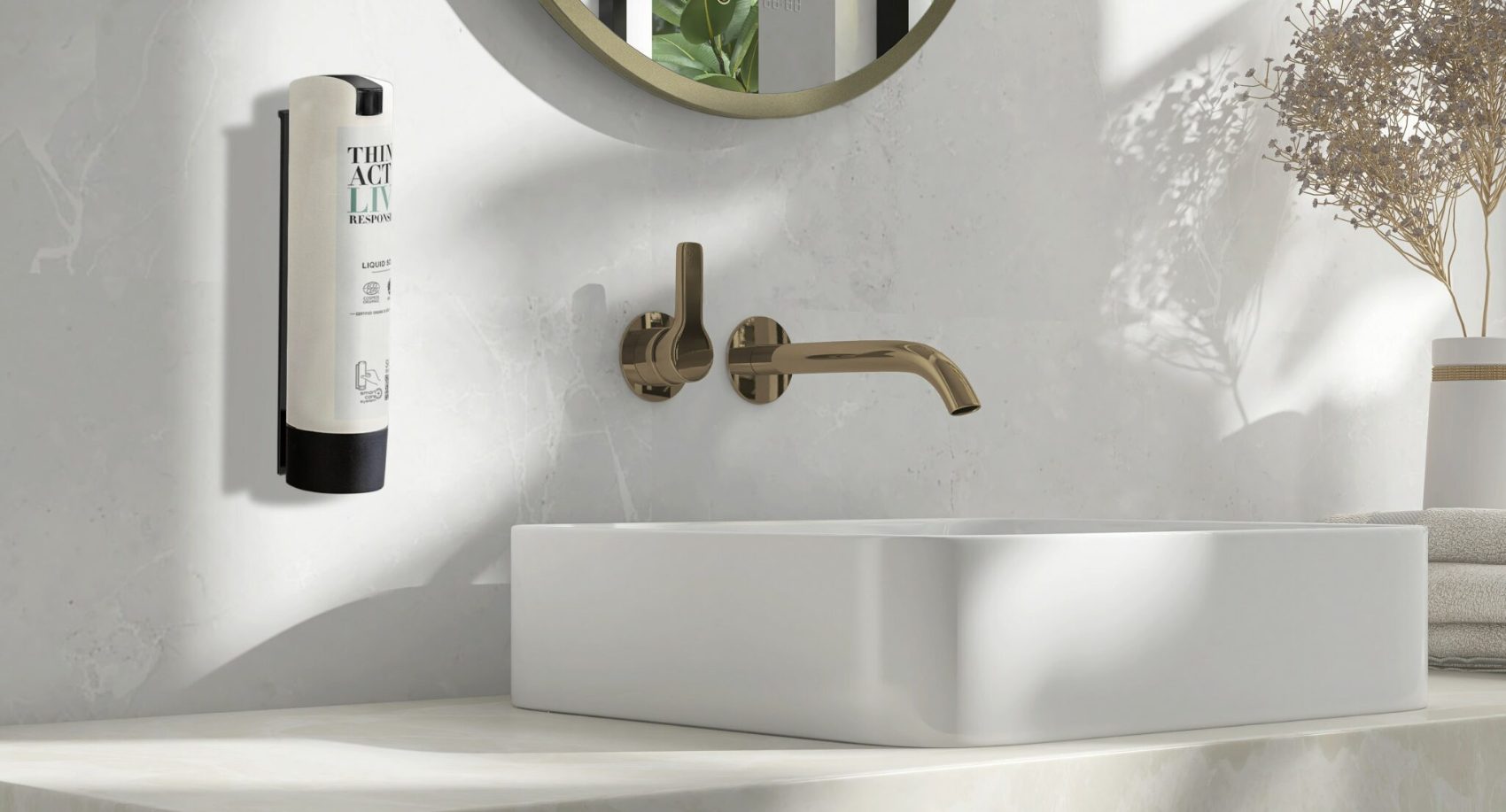
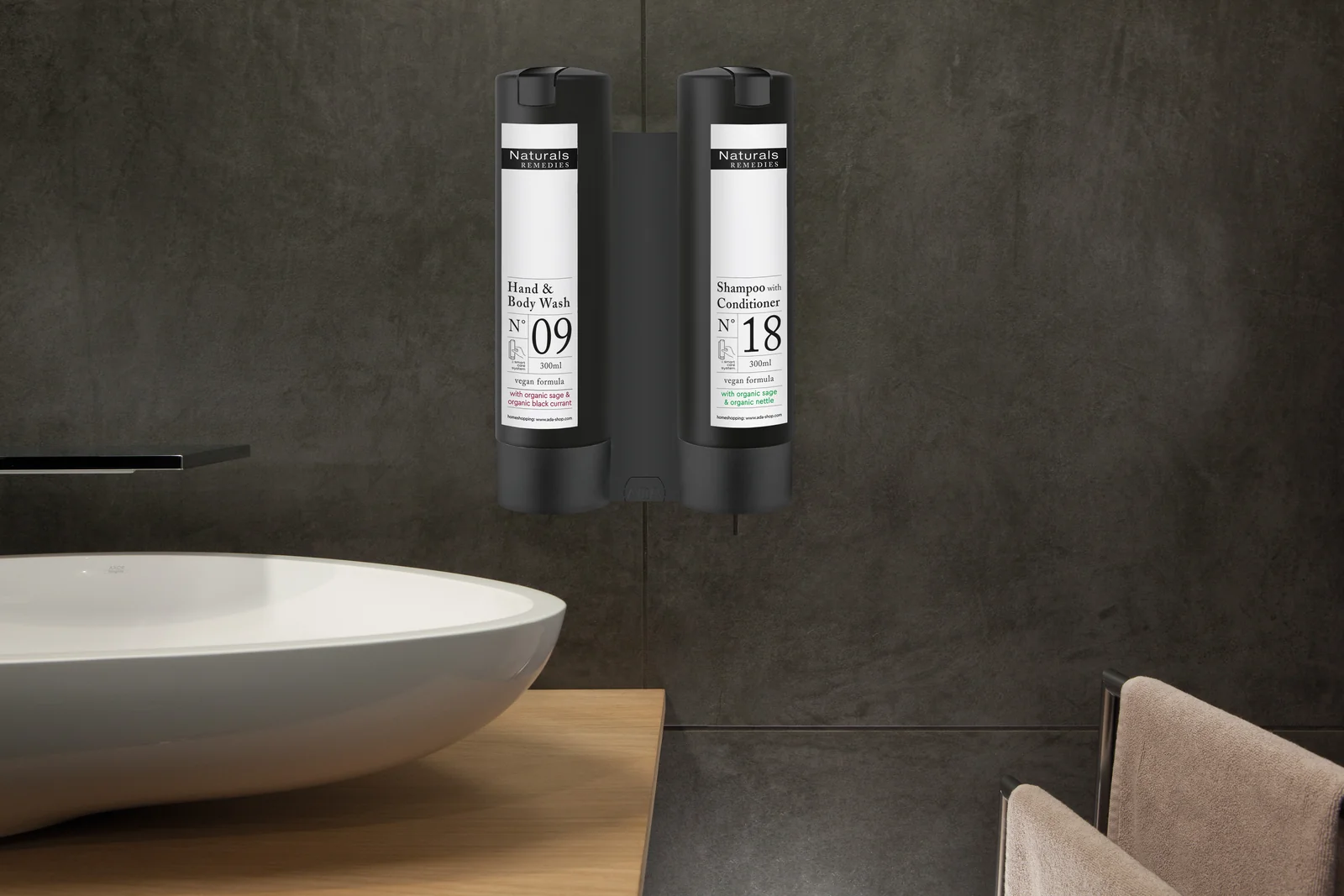
The example is a calculation for a hotel with 80 rooms, on average 65% occupied, with 1.4 guests per occupied room, that replaces three miniatures daily (shampoo, shower gel, body lotion). Over a year that is 56,940 bottles. With refillable dispensers, the 300 ml bottles are refilled from 5 l refills and replaced after three refills. The same hotel uses about 144 refills and 798 new bottles a year.
| Indicator | Miniatures | Dispensers | Difference |
|---|---|---|---|
| Plastic in primary packaging, per year | 455.5 kg | 46.4 kg | 409.1 kg (90%) |
| Plastic avoided per room, per year | — | — | 5.11 kg |
| CO2 from packaging plastic, per year | 1,426 kg CO2e | 128 kg CO2e | 1,298 kg CO2e (91%) |
How we calculate the figures
We start from the year’s guest-nights (rooms × days × occupancy × guests per room) and from the product consumed per guest-night. From these come the miniatures no longer bought, the 5 l refills and the dispenser bottles needed. Plastic is the number of packs multiplied by their weight: 8 g for the 35 ml bottle with cap, 39 g for the 300 ml dispenser bottle with cap, 106 g for the 5 l refill with cap, according to the production data received from ADA Cosmetics. For CO2 we apply, by material, the emission factors published by the UK government (DESNZ, conversion factors 2026), with the waste going to landfill. The full calculation, with the formulas in plain view, is in the calculation sheet.
What is counted
Packaging weights come from production data confirmed by ADA Cosmetics for this example. For ADA Cosmetics customers, the data appears on the invoice and is available on request.
The plastic of the primary packaging is counted, bottle and cap; labels, cartons and transport are excluded, and the cosmetic inside the pack is not covered by the CO2 figure. Replacing the dispenser bottle with a new one after three refills is the practice Concept Hotels already uses with clients who have dispensers, and recommends; in the sheet, the number of refills can be changed. The consumption of 12 ml per guest-night is the working figure for rinse-off products; for lotion it is an upper limit, checked against actual consumption.
Recycled content is counted only where ADA gives the percentage, which is the 35 ml bottle (25% recycled PET). Other ADA packs are marked as recycled (PCR) but without a percentage; they are treated as virgin material, so the figures lean cautious rather than inflated.
Miniatures are counted per room-night and dispensers per guest-night at 12 ml, so the comparison also includes the saving of product thrown away half used. With equal product volume on both sides, the plastic reduction comes out at 78.8%. For comparison, the ADA sustainability report gives 75% less plastic when switching to dispensers and, with the Refillution system, up to 95%, on average 4.5 kg per room per year; the 90% in the example lies between the two, and 5.11 kg per room is close to ADA’s 4.5 kg.
The link to 2030
Regulation (EU) 2025/40 (PPWR), Article 25 and Annex V point 5, bans from 1 January 2030 the placing on the market of single-use packaging for cosmetic, hygiene and toiletry products intended for a single booking in the accommodation sector. The regulation sets no volume threshold: what matters is that the pack is used for a single booking. The details are in the article PPWR and hotels: what changes in 2030. The sheet is not a certificate of compliance; it is a working document for the hotel’s report.
How to get the sheet for your hotel
The sheet is provided on request, after an individual analysis of the hotel’s actual data: occupancy, the number of overnight stays (occupied beds or another indicator the hotel uses) and the number of products delivered, set against the consumption period. The data comes together with the invoice for the delivered products, for the period the hotel requests, and is matched with the supplier’s data for each hotel.
Dragoș Popescu
Dragoș Popescu founded Concept Hotels in 2001. Since 2004 the company has been ADA Cosmetics’ distributor for Romania and the Republic of Moldova, and it works directly with Indel B and Aliseo on equipping hotel bathrooms and guest rooms.
About Concept Hotels →Sources (4)
- ADA Cosmetics, packaging production data (35 ml bottle, 300 ml dispenser bottle, 5 l refill), received by Concept Hotels in October 2026.
- UK DESNZ, Greenhouse gas reporting: conversion factors 2026: https://www.gov.uk/government/publications/greenhouse-gas-reporting-conversion-factors-2026
- ADA Cosmetics, sustainability report (75% less plastic with dispensers; up to 95% and on average 4.5 kg per room per year with Refillution).
- Regulation (EU) 2025/40 on packaging and packaging waste, Article 25 and Annex V point 5: https://eur-lex.europa.eu/legal-content/EN/TXT/?uri=CELEX:32025R0040