The PPWR compliance calendar: why the target year is 2029, not 2030
The ban starts on 1 January 2030. Fitting happens in winter, a pilot takes a season, a contract takes a budget. The real year-by-year calendar for hotels.
The whole market says "2030". It is the date in the regulation and, for a hotel, it is the wrong date. This article explains why and lays out the calendar year by year, with the method in plain view: what is legal text and what is project experience.
What the regulation says, exactly, and what it does not
Regulation (EU) 2025/40 on packaging and packaging waste, known as PPWR, applies from 12 August 2026. Article 25(1) states: "From 1 January 2030, economic operators shall not place on the market packaging in the formats and for the purposes listed in Annex V."
Annex V, point 5, describes the format that concerns hotels: "single-use packaging for cosmetics, hygiene and toiletry products for use in the accommodation sector [...], intended for an individual booking and intended to be discarded before the arrival of the next guest". The regulation's own examples are shampoo bottles, hand and body lotion bottles and wrappers around bar soap.
Three things the text does not say, which general sources tend to confuse:
- There is no millilitre threshold. The regulation does not say "under 50 ml" or "under 100 ml". The test is functional: single-use packaging, for one booking, discarded before the next guest. A 100 ml bottle thrown away after each guest falls under the definition; a 300 ml bottle that stays in the bathroom and is refilled does not.
- It is not limited to plastic. Points 1–4 and 6 of Annex V explicitly say "plastic"; point 5 does not. A single-use bottle of any material is treated the same way.
- There is no exemption for small establishments. The micro-enterprise derogation in Article 25(4) concerns only point 3 of the Annex (food and drink in HORECA), not cosmetics.
A fourth point, decisive for the calendar: the regulation bans placing on the market, defined in Article 3 as "the first making available of packaging [...] on the Union market". It does not ban use. We return to this in section 5.
Why "2030" is the wrong date for a hotel
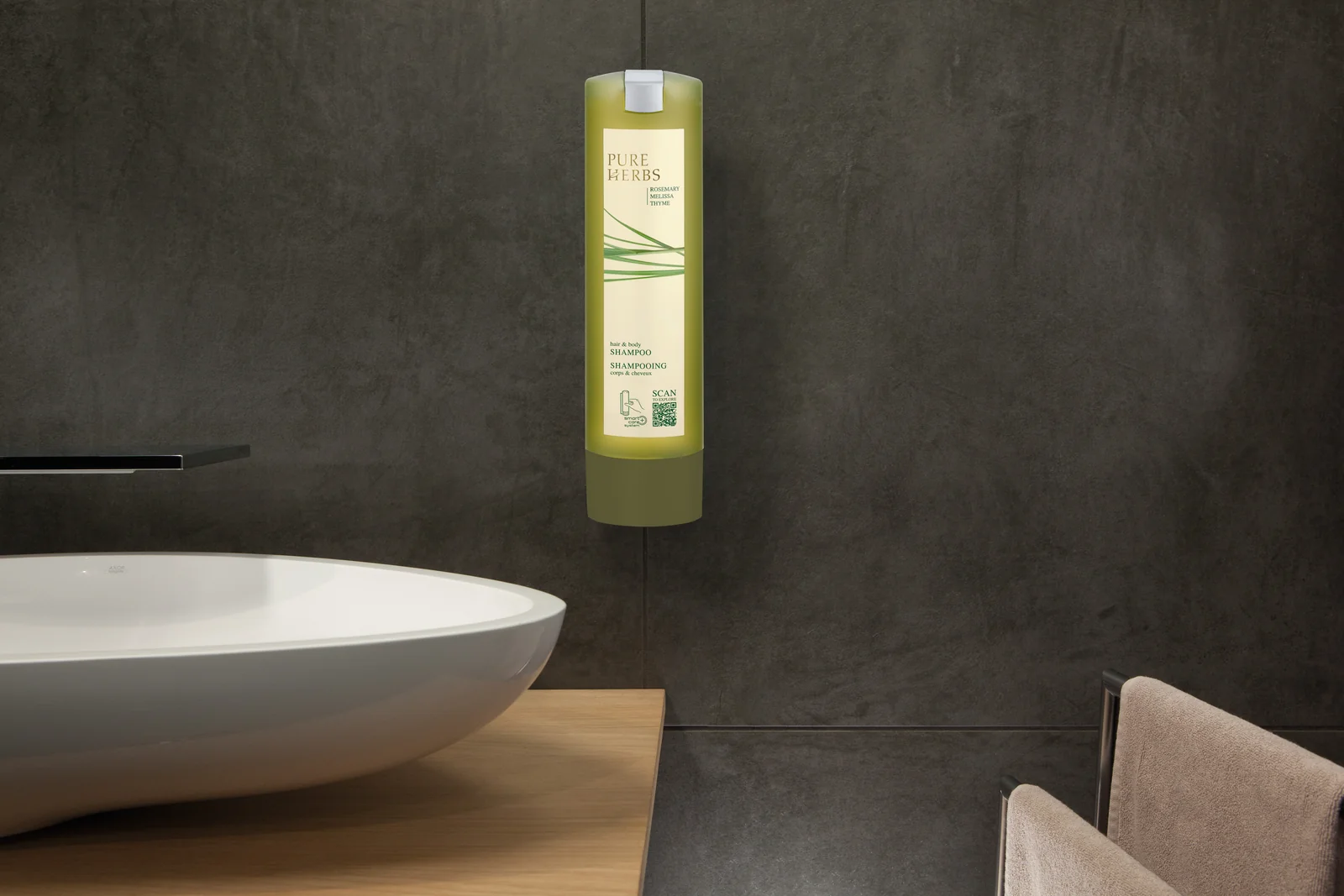
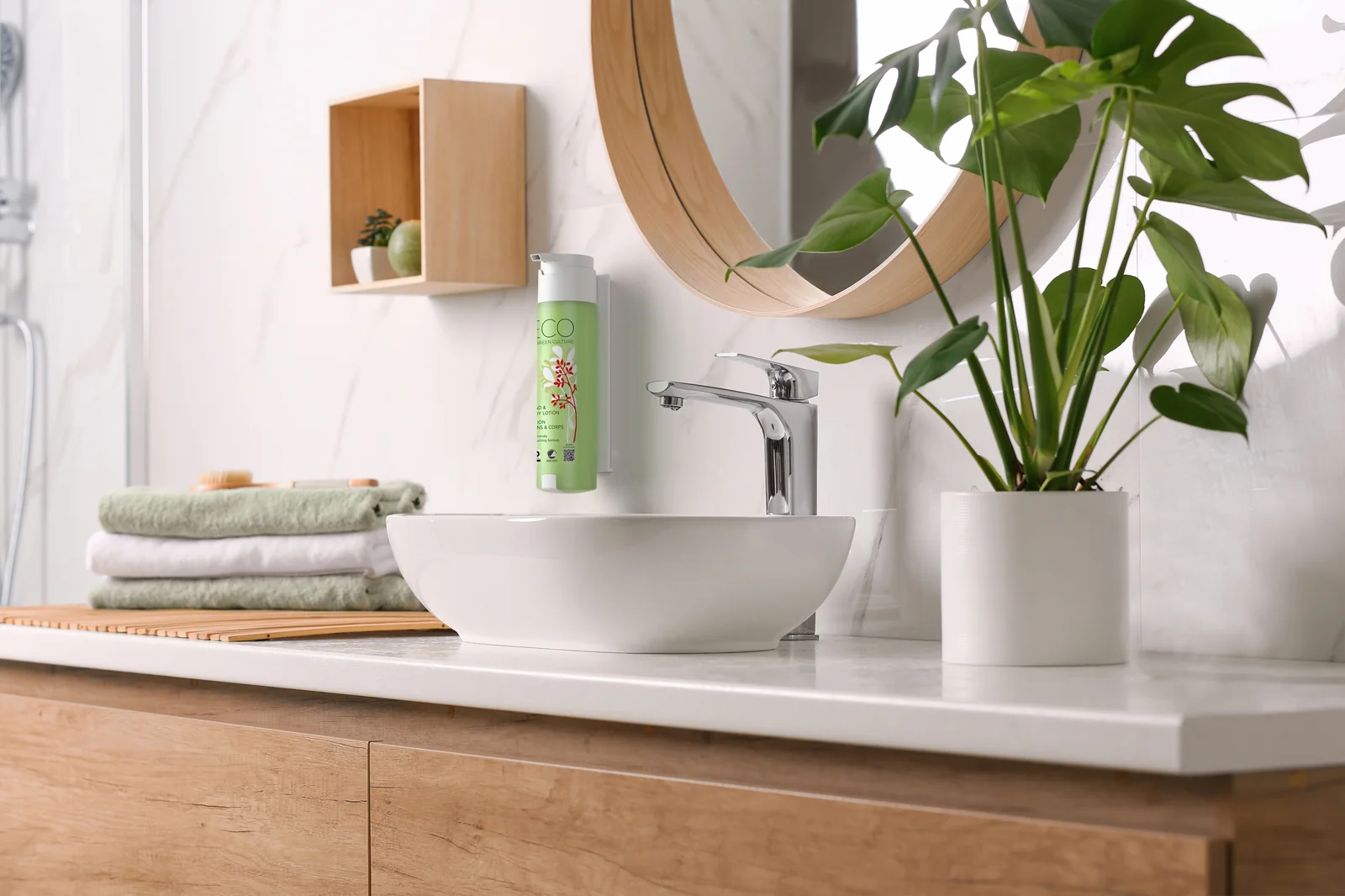
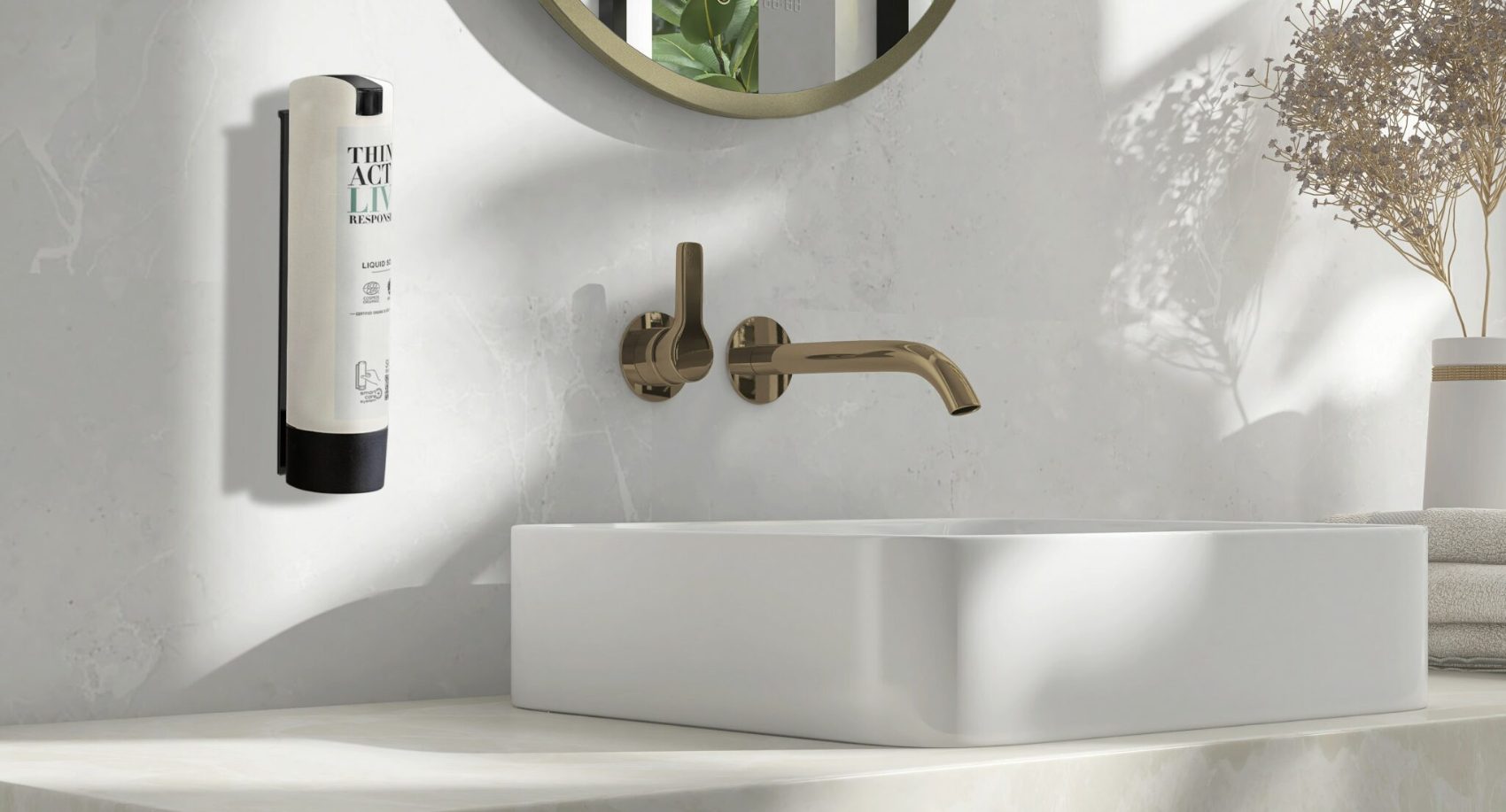
The legal date applies to manufacturers and importers: from 1 January 2030 they can no longer put the format on the market. For the hotel, the date does not mark the start of a transition but its end. On that day, every room must already have a system that does not depend on the vanished formats: refillable dispensers fitted, a refill contract signed, stock turning over, a supplier you have worked with for at least one season.
None of this gets done in December 2029. And between "we have heard of PPWR" and "we have dispensers in every room" lie, in our project experience, 18 to 30 months. This is an operational calendar, not one imposed by legislation, and we present it as such.
The constraint nobody budgets for: the renovation window
In Romania, hotel bathrooms are worked on in winter. The season does not allow rooms out of service, and fitting dispensers in 100 rooms means drilling or bonding on tiles, leak checks, housekeeping training and a few days without each room. The realistic window is October to March.
The last full window before the deadline is October 2029 – March 2030. It cuts the deadline in half and leaves no margin for a late supplier or a postponed floor. The window you can rely on is therefore October 2028 – March 2029. To reach it with a decision made and a budget approved, the pilot must have run in 2028 and the tenders must go out in 2027.
The calendar, year by year
| Stage | Realistic duration (project experience) | What happens |
|---|---|---|
| Inventory of bathroom formats | 2–4 weeks | How many rooms, which formats, which contracts and until when |
| Tender and comparison | 2–3 months | At least three suppliers, on five-year total cost, not list price |
| Pilot on one floor or one room category | one full season | Real consumption, guest reaction, housekeeping time |
| Decision and framework contract | 1–2 months | Goes into next year's budget |
| Fitting in all rooms | the renovation window | October to March |
| Stock run-in and adjustment | 2–3 months | Until consumption and delivery frequency settle |
Hence the calendar we use in every hotel conversation:
- 2026 — inventory. How many rooms still have individual formats, which contracts are running and until when. The regulation has applied since 12 August 2026.
- 2027 — tenders. Requests for quotation, samples, total-cost comparison. On 12 February 2027 the European Commission publishes guidelines explaining Annex V "in detail, including examples of packaging formats" (Article 25(6)); read them before signing anything. Also on 12 February 2027, hotels selling take-away food or drink must accept customers' own containers (Article 32) — a separate obligation, but a sign that the pace has changed.
- 2028 — pilot and decision. One floor, one full season, measured. Then the framework contract, in the 2029 budget.
- 2029 — the year you are ready. Fitting in all rooms in the October 2028 – March 2029 window, stock turning over, supplier tested.
- 1 January 2030 — the legal deadline. A hotel that arrives here unprepared does not pay a fine; it buys under pressure, whatever is left.
The real risk is not the fine, it is supply
Because the regulation targets placing on the market, not use, stock of bottles bought legally before 2030 does not become illegal overnight. We say this openly, because honesty here is worth more than a scare. What changes is something else: from 1 January 2030 the supplier can no longer deliver the format. A hotel that has not moved to refillable dispensers is left without a source, not with a penalty, in exactly the season when continuity matters most.
The second thing good sources say and weak ones do not: a refillable dispenser does not automatically make the refill inside it compliant. The regulation applies to packaging, and the 3 or 5 litre refill is packaging too, with its own requirements on recyclability, recycled content and labelling. Compliance is assessed on the whole system: dispenser, refill, documentation. A cheap wall bracket with a refill that has no technical sheet is not a transition to PPWR; it is a postponement. The question to ask a supplier is not "how much is the bracket" but "do you have the technical sheet of the refill packaging, with material, weight and certifications?".
For city hotels with short stays, where bottles were replaced daily, the switch also has a cost effect: at hotels that replaced individual bottles daily, moving to dispensers cuts cosmetics cost by more than 50% — verified across all 38 comparable product pairs in the ADA range. The full per-room, per-night calculation is in Bottle or dispenser: the cost per room. At the seaside, in the mountains or in spas, where stays are long and bottles change only between guests, the argument is different: the deadline, waste, housekeeping time and the guest experience.
What to do in the next four weeks
- Count. Rooms, formats per room category, cosmetics contracts and their expiry dates.
- Ask for the technical sheets of the packaging you use now. If the supplier does not have them, you already have the answer to "who do we continue with".
- Put the next renovation on the calendar. If it falls before March 2029, the fitting goes into it. If not, you need a separate window.
- Choose the system to test. Refillable dispensers differ in hygiene (closed or open refill), format and brand; the comparison is on Dispensers, the refill logic on Refilling.
- Ask for the calculation on your number of rooms — we send one page with the hotel's position on the 2029 calendar and what to do in the next 12 months: For your hotel.
Our PPWR for hotels page keeps the regulation text and the calendar current; we update it with every guideline the Commission publishes.
Frequently asked questions
What does PPWR ban in hotels from 1 January 2030?
Placing on the market single-use packaging for cosmetics, hygiene and toiletry products intended for a single booking and discarded before the next guest (Annex V, point 5). The regulation's examples: shampoo bottles, lotion bottles, soap wrappers.
Is there a 50 ml or 100 ml threshold?
No. The regulation sets no volume threshold for hotel cosmetics; the test is single use for one booking. The Commission's guidelines of February 2027 will bring concrete examples.
Can I use stock bought before 2030 after the deadline?
The regulation targets placing on the market, not use, so legally purchased stock does not become illegal. The problem is that after 1 January 2030 it can no longer be delivered; that is why the target year is 2029. For your hotel's specific situation, consult a legal adviser.
I have installed dispensers, so I am compliant?
Not automatically. The refill in the dispenser is packaging too and has its own requirements; compliance is assessed on the whole system — dispenser, refill, documentation.
Why 2029 and not 2030?
Because fitting happens in the October–March renovation window, a pilot takes a season, and a contract takes an approved budget. The last safe window is October 2028 – March 2029.
Dragoș Popescu
Dragoș Popescu founded Concept Hotels in 2001. Since 2004 the company has been ADA Cosmetics’ distributor for Romania and the Republic of Moldova, and it works directly with Indel B and Aliseo on equipping hotel bathrooms and guest rooms.
About Concept Hotels →Sources (1)
- Regulation (EU) 2025/40 of the European Parliament and of the Council of 19 December 2024 on packaging and packaging waste — Article 3(10), Article 25, Articles 32 and 33, Article 71, Annex V point 5 (EUR-Lex, OJ L 2025/40, 22.1.2025). Stage durations in the calendar are Concept Hotels' own estimate from its projects, not legal requirements.